


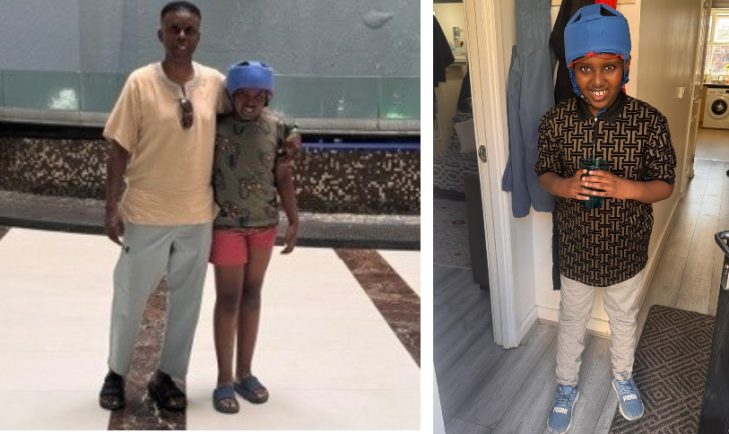
A DAD from Rubery is backing a UK-wide campaign for greater awareness of Dravet Syndrome, a rare life-limiting condition which affects his son.
Adam Shirwa is among those helping Dravet Syndrome UK spread the word and raise vital funds. They are sharing their stories during June, the condition’s awareness month.
Dravet Syndrome affects only one in every 15,000 live births. It is one of the most common genetic epilepsies, as well as one of the most treatment resistant.
In around 85 per cent of cases, it is caused by a mutation in a gene known as SCN1A.
Adam’s son, Mo, had his first seizure at six months old. He was diagnosed with Dravet Syndrome at the age of one.
Adam said: “Mo’s first seizure was an experience I will never forget and it will always stay with me.
“He was six months old. He started shaking against me – I was terrified and I didn’t know what to do.
“I hadn’t seen a seizure in ‘real life’ before, only on television.
“I didn’t know what was going on.”
Rushed to hospital
Mo was rushed to hospital where Adam was told the seizure was a febrile convulsion, considered ‘normal’, and they were were sent home.
But, from then on, there was not a week that went by where they did not visit the hospital. Mo was averaging around three seizures a week.
It became obvious very quickly there was something else going on.
About six months after Mo’s first seizure, Adam was out shopping with him in Birmingham city centre. He had a huge seizure that lasted for an hour.
“In hospital, I sat in a corner of the room while Mo was having repeated seizures.
“The doctors and nurses were surrounding him.
“I vividly remember the feeling of dread, waiting for one of them to turn to me to say that we had lost our son.
“Eventually, they were able to stabilise him and he started to recover.”
Adam was persistent in pushing the doctors to find out what was going on. The neurologist then undertook genetic tests to rule out a genetic condition. Three months later, Mo was confirmed with having Dravet Syndrome.
Epilepsy is just one part of the condition. As well as seizures, Dravet Syndrome causes learning disability and a spectrum of associated conditions, which may include autism, attention-deficit hyperactivity disorder (ADHD), challenging behaviour, and difficulties with speech, mobility, feeding and sleep.
Because children and adults with Dravet Syndrome have such complex medical needs, often requiring emergency care, lack of awareness can make living with this devastating condition even more challenging for families.
For example, some commonly used epilepsy medications, known as sodium channel blockers, can make seizures worse for those with Dravet Syndrome.
Diagnosis changed the situation
Adam said Mo’s diagnosis was a game-changer, adding they had that, he was put on more appropriate medication.
Adam and the charity hope telling first hand stories will help with earlier diagnoses and more timely access to treatments, therapies and support for those affected.
Early signs of Dravet Syndrome include prolonged seizures (often triggered by fever) in early infancy.
Anyone suspecting their child of having Dravet Syndrome can ask their GP, paediatrician or epilepsy consultant if they have one, for a genetic test.
Visit: dravet.org.uk or email the charity at: [email protected] for more.