


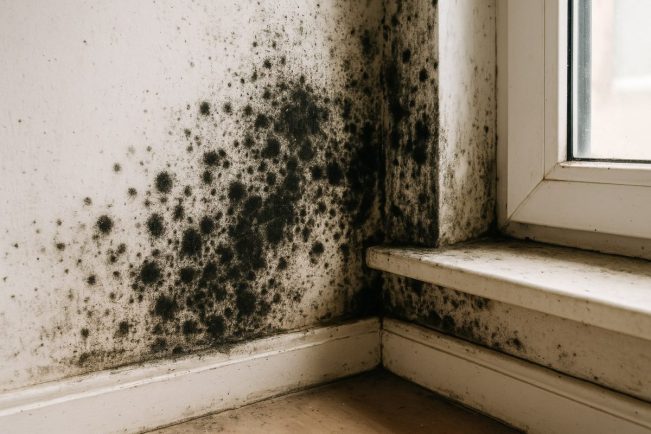
BLACK patches creeping up the bedroom wall, a musty smell that won’t shift, condensation running down the windows every morning. If you rent in or around Bromsgrove, you’ve probably either dealt with this or know someone who has.
The law gives tenants more protection than most people realise, but only if you know what to ask for. Continue reading to find out exactly where you stand and how to push your landlord into action.
What Your Landlord Has to Fix by Law
Under Section 11 of the Landlord and Tenant Act 1985, your landlord has to keep the structure and exterior of the property in repair. That covers the walls, roof, windows, drains and gutters, plus the systems for water, gas, heating and electricity. If damp is coming in through a leaking roof or a broken gutter, that’s squarely the landlord’s job to sort out.
The tricky part is that not all damp counts as disrepair. Condensation caused by poor ventilation or no proper heating often slips through the gap. That’s where the Homes (Fitness for Human Habitation) Act 2018 comes in.
It says a rented home has to be fit to live in for the whole tenancy, and serious damp and mould can make a home unfit. The useful bit for you is that you can bring a claim against your landlord directly under this Act without waiting for the council to step in, though it’s worth getting legal advice first and following the housing disrepair pre-action protocol.
What a Proper Mould Removal Job Involves
When your landlord finally agrees to act, it’s worth knowing what good work looks like so you don’t get fobbed off. Painting over mould with anti-mould emulsion doesn’t fix anything. The spores stay behind the paint and come straight back through within weeks. A real job deals with the cause first, then the damage.
Done properly, the work starts with a moisture survey to find where the water is actually coming from, whether that’s a leak, rising damp or condensation in a cold, badly ventilated room. A specialist mould remediation firm like ICE Cleaning will carry out that survey before any treatment begins. From there, a proper remediation tends to involve:
Tracing and fixing the source of the moisture
Removing and safely disposing of badly affected materials
Treating surfaces with an antimicrobial product to kill remaining spores
Drying the structure out fully before any redecoration
If your landlord sends someone round with a tin of paint and nothing else, the problem isn’t being fixed. It’s being hidden.
Awaab’s Law and the Changes Coming for Private Renters
You’ve probably heard of Awaab’s Law, named after two-year-old Awaab Ishak, who died after prolonged exposure to mould in his family’s social housing flat. Since 27 October 2025, social landlords have had to investigate and deal with damp and mould within fixed legal timeframes. Right now those rules only apply to social housing, not private lets.
The Renters’ Rights Act 2025 contains the framework to extend Awaab’s Law to private tenancies, so private landlords will eventually face the same clock. The exact start date is still to be confirmed and depends on further government consultation, so don’t assume it applies to your tenancy yet. Even so, the direction is clear, and your existing rights under Section 11 and the 2018 Act already give you plenty to work with.
How to Get the Council Involved
If your landlord keeps stalling, your next move is to contact Bromsgrove District Council’s Private Sector Housing team. You can submit a complaint through the council’s website, and they can inspect your home under the Housing Health and Safety Rating System.
Serious damp and mould is treated as a hazard. If they agree, the council can serve an improvement notice forcing the landlord to act. Ignoring that notice is an offence, and from 1 May 2026 councils in England can issue civil penalties of up to £40,000 as an alternative to prosecution, raised from the previous £30,000 cap under the Renters’ Rights Act 2025.
There’s a financial angle too. Under the Renters’ Rights Act, the maximum rent repayment order has doubled from 12 to 24 months’ rent from 1 May 2026. If a landlord commits certain offences, such as ignoring an improvement notice, a tenant can apply to the First-tier Tribunal to claim a chunk of their rent back.
Before you reach that stage, Shelter and Citizens Advice both offer free guidance on how to put your complaint in writing and build a record. Citizens Advice Bromsgrove and Redditch runs a phone advice line on 0808 278 7890 and can arrange face-to-face appointments where needed.
Make the Law Work for You
The single most useful thing you can do is keep evidence. Photograph the mould, date everything, and report problems to your landlord in writing so there’s a paper trail. A landlord who knows you understand your rights, and who can see you’ve documented every report, will usually act far quicker than one who thinks you’ll let it slide.
Article written by Lydia White