


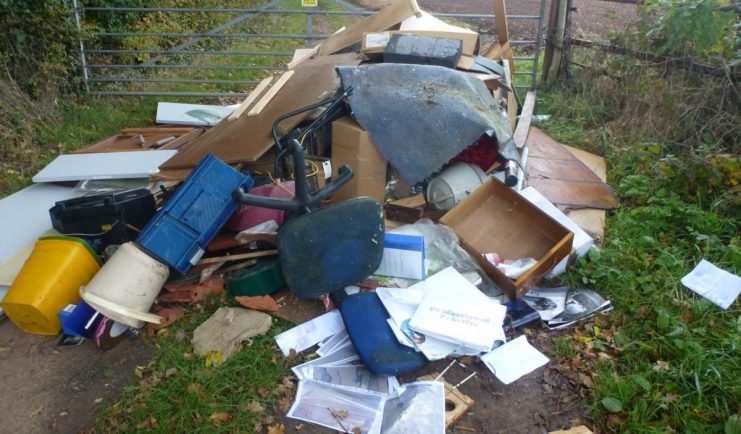
BROMSGROVE District Council has intensified its crackdown on illegal waste disposal, actively penalising householders who fail to verify where their domestic rubbish ultimately lands. Recent enforcement actions have resulted in excess of £5,000 in financial penalties being levied against residents who inadvertently financed fly-tipping operations.
The sudden surge in fixed penalty notices highlights a widespread, and costly, public misunderstanding of the household waste duty of care. Under current UK environmental legislation, a homeowner’s liability does not simply vanish once a sofa or a pile of broken plasterboard leaves their driveway. If a rogue operator subsequently dumps that debris on a rural kerb or down a quiet country lane, the original owner remains legally culpable and faces immediate prosecution.
The Legal Reality of Household Waste
The logistics of managing domestic renovations often push property owners toward the cheapest, most immediate disposal options. According to reports of easySkip, a popular skip hire provider, a standard residential bathroom refit generates approximately two to three cubic yards of dense, mixed waste. Corresponding reports from the Environment Agency suggest that heavy construction and demolition debris of this exact nature accounts for roughly a third of all recorded small-scale fly-tipping incidents across the region.
Many of the recent fines in Bromsgrove stem directly from the informal “man with a van” sector. These operators frequently advertise on local community social media boards, offering cut-rate clearance services that dramatically undercut licensed disposal facilities. The structural problem is relatively straightforward: legitimate waste processing is an expensive endeavour, heavily regulated and hampered by steep landfill taxes. Operators charging unrealistically low fees almost exclusively bypass these overheads by abandoning their loads in isolated areas rather than paying commercial weighbridge fees.
Householders are legally required to verify that anyone removing waste from their property holds a valid, upper-tier Waste Carrier Licence. This verification process involves requesting the operator’s registration number and actively checking it against the official public register. Taking a photograph of the vehicle’s registration plate and retaining a written receipt detailing the exact nature of the waste and its agreed destination are also considered standard, necessary precautionary measures by environmental enforcement officers.
The Cost of Complacency
For those caught in the council’s enforcement net, the financial repercussions far exceed the initial savings of a cheap cash-in-hand clearance. Fixed penalty notices for duty of care offences are steep, and a failure to pay can lead to a criminal record alongside significantly higher fines imposed by a magistrates’ court. The council’s recent £5,000 penalty milestone demonstrates a zero-tolerance approach, relying heavily on physical evidence sifted from the dumped rubbish itself—such as addressed correspondence, delivery boxes, and highly distinct household items.
Local authorities face mounting clean-up costs for fly-tipping, expenses which are inevitably absorbed by the local taxpayer. Consequently, enforcement teams are becoming increasingly proactive in their investigations. They now regularly deploy hidden cameras in notorious rural dumping hotspots and work backward, following the paper trail directly to the oblivious homeowner.
To mitigate these risks, the official guidance remains unambiguous. Property owners must exercise strict due diligence, prioritising established, transparent disposal routes over informal, undocumented arrangements. Ensuring that waste is handled by entities operating strictly within the bounds of environmental regulations is the only guaranteed method to prevent a weekend DIY project from resulting in a severe financial penalty.
The Broader Strain on Local Infrastructure and Green Spaces
Aside from the direct financial sting of a fixed penalty notice, the compounding effect of illegal dumping places a severe operational burden on Bromsgrove’s municipal infrastructure. When rogue operators abandon transit van loads of broken tiles, rotting timber, and heavy hardcore in lay-bys or across public footpaths, the local council is legally obligated to clear the obstruction. This procedure is rarely as simple as dispatching a standard refuse lorry. Hazardous materials, including degraded asbestos roofing sheets and chemical solvents that are frequently concealed within general DIY waste, demand specialised handling teams and expensive, heavily regulated containment protocols.
The rural fringes of the district, defined by narrow, unlit lanes and expansive agricultural borders, consistently bear the brunt of this illicit activity. Farmers and private landowners face a particularly grim reality; if waste is deposited on private acreage, the local authority holds no responsibility for the subsequent clean-up. Instead, the landowner is forced to absorb the exorbitant commercial removal fees themselves. The National Farmers’ Union has repeatedly highlighted this specific issue as a growing rural crisis, noting that agricultural gates are frequently rammed and ancient hedgerows deliberately destroyed just to grant rogue tippers access to secluded fields.
Addressing this wave of environmental vandalism, community watch groups across Worcestershire have begun collaborating more closely with local enforcement officers. Residents living in outlying villages are being urged to log the descriptions and registration numbers of unfamiliar commercial vehicles seen loitering in quiet rural corridors. Authorities stress, however, that residents must never confront suspected fly-tippers directly. The individuals involved in orchestrated, large-scale waste crime can be highly volatile and are sometimes linked to other forms of organised illicit enterprise.
The recent £5,000 penalty milestone is viewed by the council as a deterrent rather than a definitive victory. The district’s waste management infrastructure remains stretched, forced to balance routine municipal refuse collection against the unpredictable demands of investigating and clearing spontaneous illegal dumps. Until the broader public stops handing cash to undocumented carriers, the cycle of dumping and wasted municipal expenditure will persist. The overarching message from enforcement teams is clear: protecting the local environment requires every householder to treat their rubbish with the exact same level of scrutiny they would apply to hiring a certified gas engineer or electrician. Ignorance of environmental law is no longer accepted as a valid defence in court, and the investigative net is fully expected to tighten in the coming months.
Article written by George James