



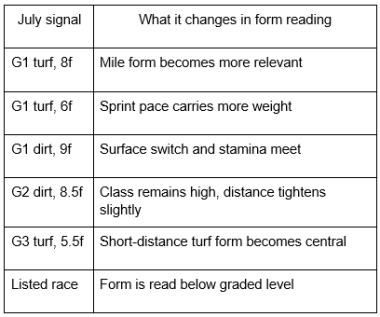
July’s stakes calendar is not vague at all: a 13-furlong G3 turf race on July 9, an 8-furlong G1 turf race on July 10, a 6-furlong G1 turf sprint on July 11, then a $1 million G1 dirt race over 9 furlongs on July 18. That is the real reason form becomes the centre of horse race betting online during stakes season. The races are close together, but they do not ask the same question. A sprinter, a miler and a 9-furlong dirt runner can all look sharp on paper. The racecard decides what that sharpness actually means.
July does not offer one kind of test
The calendar moves quickly from long turf races to short sprints. That matters because a form line only makes sense when the conditions around it are clear.
A July 9 G3 turf race over 13 furlongs asks about stamina. A July 10 G1 turf race over 8 furlongs pulls the argument back toward speed carried over a mile. The next day, a G1 turf sprint over 6 furlongs makes early pace harder to ignore.
Then July 18 changes the surface completely. A $1 million G1 dirt race over 9 furlongs sits on the same month’s stakes map as turf contests at 5.5, 8 and 11 furlongs. Same calendar, different race language.
That is why July stakes form cannot be read as one block. Distance and surface keep separating the month into separate stories.
The form line starts at the right edge
Racecards compress recent runs into a string of numbers and letters. The most recent run sits on the far right. That small rule changes the reading immediately.
A form line ending in 1 shows the latest run was a win. A line that begins with 1 but ends in 6 tells a different story. The old win is still there, but it is not the freshest evidence.
Numbers from 1 to 9 show finishing positions. A 0 means outside the top 10. Letters explain races that did not end in a normal placing: P for pulled up, F for fell, UR for unseated rider, BD for brought down and R for refused.
One example is enough. A line such as 321 is not the same as 123. Same digits, different direction. The right edge carries the latest evidence.
Class labels make the number less lonely
A finish position without class can flatter or undersell a runner. First in a weaker race and third in a G1 are not automatically comparable.
This is where abbreviations do real work. Gp marks Group level on the Flat. Gd marks Grade level over jumps. Hcap means handicap. List means Listed race.
The shorthand does not solve the race. It stops the racecard from pretending every “1” means the same thing.
Purse size adds another clue
Money is not everything in racing, but purse figures help explain why some July entries pull more attention than others.
A $1.104 million G1 turf sprint over 6 furlongs sits in a different bracket from a $225,000 G3 turf sprint over 5.5 furlongs. Both can be fast. Both can be competitive. The class and purse tell the reader that the level of pressure is not identical.
The same applies later in the month. A $500,000 G1 turf race over 9 furlongs asks a different form question from a $250,000 G2 dirt race over the same distance. Equal trip, different grade. Similar distance does not mean similar race.
That is the catch with July. The numbers look easy until they start overlapping.
Surface interrupts neat comparisons
A good turf record cannot simply be copied across to dirt. A dirt win does not automatically answer a turf question. The surface sits inside the form line, even when the recent finishing figures look tidy.
Going adds another layer. Good, firm, soft and heavy describe the ground under the race. A horse with clean form on good ground may carry a different profile when the going changes. The letters look small on the card, but they alter the reading of the whole row.
Course and distance markers sharpen the point. C means a previous course win. D means a previous distance win. CD means both. That does not turn the race into a conclusion. It simply gives the form line a more exact address.
Stakes season requires precise reading
The strongest July cards are crowded with signals: G1, G2, G3, turf, dirt, 5.5 furlongs, 6 furlongs, 8 furlongs, 9 furlongs, 13 furlongs. A runner’s last result is only one part of that picture.
That is why form sits at the centre of stakes-season coverage. It is the place where recent evidence meets race conditions. A clean sequence can lose force when the distance changes. A mixed sequence can look less messy when the race returns to the same surface.
July does not need broad claims. It has enough detail already. The form line, the class label and the distance column do the sharper work.
Article written by Amber Bailey.