

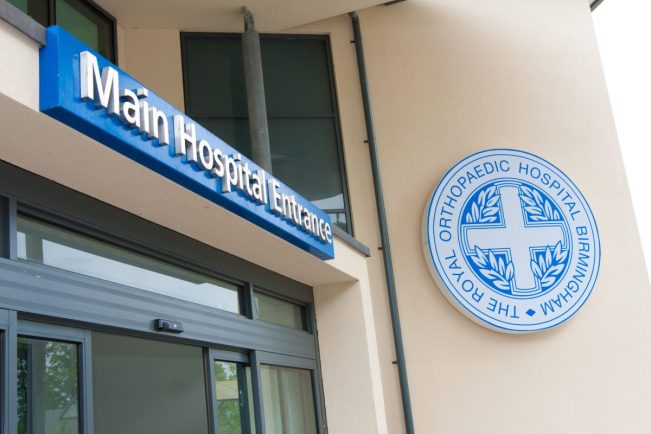
CONSULTANTS at the Royal Orthopaedic Hospital in Northfield (ROH) are starting a new clinical trial exploring the need for radiotherapy following surgery for pathological fractures on metastatic bone cancer patients.
Approximately 70 per cent of people with advanced breast and prostate cancer develop secondary bone cancer (metastases) prompting consultants to look into whether further radiotherapy treatment could reduce this worrying statistic.
This disease weakens the bone, causing ‘pathological’ fractures which then require surgery to stabilise or replace the affected bone.
Pathological fractures occur when bone breaks without any causative injury and they can be incredibly painful.
Consultants at The ROH NHS Foundation Trust are at the forefront of research into whether intervening with radiotherapy immediately following surgery to treat pathological fractures reduces pain significantly, compared to no intervention.
This is being undertaken as part of the PORTRAIT trial (Post Operative Radiotherapy in Surgically Treated Bone Metastases), a multi-centre study funded by the National Institute for Health and Care Research (NIHR).
The PORTRAIT trial is sponsored by the ROH and is led by chief investigator Mr Jonathan Stevenson, Orthopaedic oncology consultant.
Mr Stevenson said: “Following surgery for pathological fractures, patients usually receive radiotherapy.
“Despite its widespread use, there is no high-quality evidence that having radiotherapy after surgery improves pain, quality of life, or reduces the risk of needing another operation.
“Because radiotherapy has side-effects, as well as requiring additional hospital visits and scans, it is essential to understand if any benefits justify additional harms and cost.”
“This is the first time the Royal Orthopaedic Hospital will lead sponsor a clinical trial and we’re incredibly proud for the UK to be leading on this essential research.
“Metastatic bone disease is becoming more prevalent and so it’s imperative we have clear guidelines to best support our patients.”
A total of £2.2m of funding from the National Institute for Health and Care Research (NIHR) will enable the study to recruit 20 sites across the UK in a randomised trial which seeks to recruit 350 patients over the age of 18.
Professor Anthony Gordon, programme director for the NIHR Health Technology Assessment (HTA) Programme, which is funding the trial, said: “The trial will help researchers understand whether radiotherapy after surgery is beneficial for patients or not.
“Studies like this show the importance in investing in clinical research in the NHS to ensure that people have access to the best and most suitable treatments.”
The trial team is seeking new centres to join.
Email [email protected] for more information or if you have any queries. Visit www.york.ac.uk/healthsciences/research/trials/ytutrialsandstudies/trials/portrait/#tab-4 for more information.