

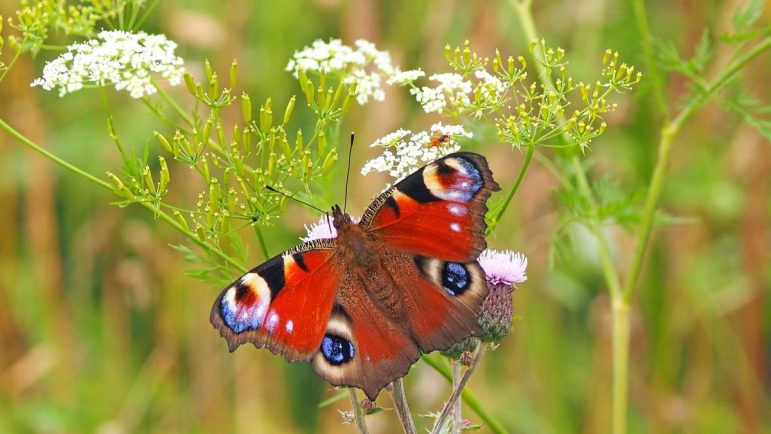
The striking Peacock butterfly has been named Britain’s favourite butterfly after coming top in a nationwide public vote organised by the charity Butterfly Conservation.
Thousands of nature lovers took part in the poll, choosing from all 60 species of butterfly found in the UK. The colourful Peacock emerged as the clear winner, beating strong competition from several other much-loved species.
The Orange-tip butterfly finished in second place, followed by the Red Admiral in third, the Holly Blue in fourth and the bright yellow Brimstone in fifth.
The Peacock butterfly is one of Britain’s most recognisable insects. Its rich red wings are decorated with large eye-like markings, known as eyespots, which help protect it from predators. When threatened, the butterfly can suddenly reveal these markings, startling birds and other animals long enough to make its escape.
Found throughout the UK, Peacock butterflies are a familiar sight in gardens, parks, woodlands and countryside hedgerows. They are particularly fond of areas where nettles grow, as these plants provide an important food source for their caterpillars.
Kate Merry from Butterfly Conservation said the response to the poll demonstrated the public’s affection for Britain’s butterflies.
She described the Peacock as a “worthy winner” and a species many people immediately think of when they picture a butterfly.
Butterflies do far more than add colour to our gardens. They play a vital role in nature, helping to pollinate flowers and providing food for birds, bats and other wildlife. Their presence is also a useful indicator of the health of the environment.
Despite their popularity, conservationists remain concerned about the future of many butterfly species. More than three-quarters of Britain’s butterflies are currently experiencing long-term declines, with habitat loss, climate change and changing land management practices all contributing to the challenge.
To help monitor butterfly populations, Butterfly Conservation is encouraging people to take part in this year’s annual Big Butterfly Count, which runs from 17 July to 9 August.
The nationwide citizen science survey asks volunteers to spend just 15 minutes counting butterflies in a garden, park or other outdoor space. The information collected helps scientists understand how different species are faring across the country and identify areas where conservation efforts are most needed.
Butterflies are among the oldest groups of insects on Earth, having existed for tens of millions of years. Today, they remain one of the most visible and cherished signs of summer.
With its dazzling colours and unmistakable wing patterns, it is perhaps no surprise that the Peacock butterfly has fluttered its way into the hearts of the British public.
Butterfly Facts: Britain’s Amazing Butterflies
Britain is home to 60 butterfly species
There are around 60 resident and regular migrant butterfly species recorded in the UK, ranging from the tiny Small Blue to the spectacular Peacock.
The Peacock butterfly is Britain’s favourite
The Peacock recently topped a nationwide poll organised by Butterfly Conservation, beating 59 other British species.
Butterflies taste with their feet
Butterflies have taste sensors on their feet, allowing them to identify suitable plants on which to feed and lay eggs.
The Brimstone inspired the word “butterfly”
Some historians believe the bright yellow Brimstone butterfly may have inspired the English word “butterfly”.
Peacock butterflies use eye spots to scare predators
The large eye-like markings on their wings can startle birds and other predators, helping the butterfly escape.
Caterpillars can eat hundreds of leaves
A Peacock caterpillar colony can strip a patch of stinging nettles remarkably quickly as they grow.
Some butterflies hibernate
Unlike many insects, adult Peacock butterflies hibernate through winter in sheds, garages, hollow trees and other sheltered spots.
Butterflies are important pollinators
While searching for nectar, butterflies help pollinate wildflowers and garden plants.
The fastest British butterfly is the Red Admiral
Red Admirals are powerful fliers and can travel long distances during migration.
Butterflies have been around for millions of years
Scientists believe butterflies first evolved at least 50 million years ago, and possibly much earlier.
Many British species are under threat
More than three-quarters of UK butterfly species have experienced long-term declines due to habitat loss, climate change and changing land use.
You can help butterflies at home
Planting lavender, buddleia, marjoram and other nectar-rich flowers can help support butterflies in gardens and green spaces.
Britain’s Top Five Favourite Butterflies
Peacock
Orange-tip
Red Admiral
Holly Blue
Brimstone
Did you know? A group of butterflies is sometimes known as a flutter, which seems rather fitting for one of Britain’s most-loved insects.