


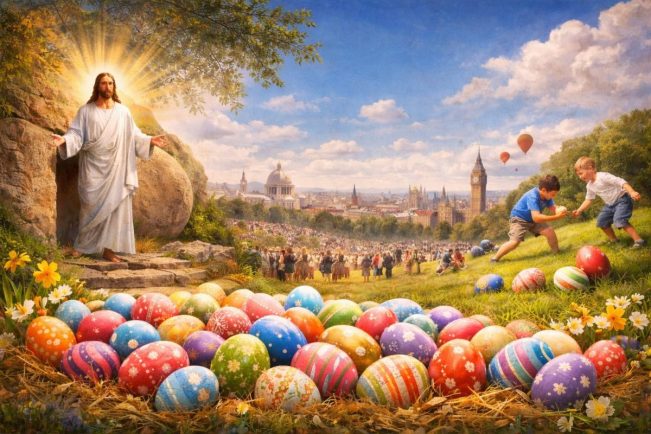
Easter is here, the Christian festival with half the fuss of Christmas, but perhaps double the message and thrice the power.
Over the centuries, Holy Week, the seven days from Jesus first entering Jerusalem, hailed as the Messiah, to his resurrection from death, has slipped from the centre of our national consciousness.
Christmas, with all its spectacle and sentiment, has eclipsed it. Yet this was not always so. Over the Easter holiday in 1926, there were said to be 10,000 Easter eggs on display in London. Families gathered on Hampstead Heath to celebrate the risen Lord. It was a moment of shared faith, of public joy, of collective meaning.
So why has Easter become the lesser of the two festivals?
When Easter is the crux of the faith, the single moment in time when everything changed. God did not merely confront evil, he triumphed over death itself. There can be nothing in the history of the world more significant than the message that death is not the end.
And yet we take this miracle of all miracles for granted.
Though many of us would not profess to be Christians, believers in Christ the Messiah, we nevertheless assume, almost instinctively, that when our loved ones die, they will go to heaven, that we will be reunited one day. It is a comforting thought, woven quietly into the fabric of our culture.
But without Easter there is no heaven. There is only death, a void, an emptiness, a final separation from God. The end.
God is the Alpha and the Omega. Jesus said, “I am the way, the truth and the life.” He said he is the light of the world. At Pentecost he poured out his spirit onto the disciples. The Holy Trinity, God the Father, the Son and the Holy Spirit, is not simply a matter of religion, it is everything. It is the answer to the deepest questions we can ask, the meaning of existence embodied in one man, Jesus Christ, sent to earth to teach us, to love us, to die for us, and to rise again, reconciling us with our maker. As Douglas Adams once joked, it is 42, the meaning of life, the universe and everything, only here the answer is not a punchline but a person.
There should be nothing to disturb your joy on Easter Day. The accomplishment of Christ is so immense that it reshapes everything. Eternal life means that the soul within you need never die.
We celebrate the day Christ rose from the dead, and to deepen that joy, we might revive some of the lost traditions and delightful absurdities once associated with Easter, for many of them are so eccentric, so joyfully ridiculous, that they cannot fail to lift the spirit.
Pancake tossing and pancake racing, for instance, are said to have begun when a housewife, hearing the church bells, feared she would be late, and ran out of her home, frying pan still in hand. In Leicestershire, there is the Hare Pie Scramble, where a great pie is baked and villagers scramble for pieces in a cheerful melee. If that sounds a little energetic after a hearty lunch, then an egg jarping contest may be more appealing, two players knocking hard boiled eggs together until one cracks. Or climb a hill and roll your eggs down, racing not only for speed but for survival. On Easter Monday there is the curious custom of heaving, men lifting the women in their lives, before the roles are reversed on Tuesday. Children, meanwhile, might perform Pace Egging plays, retelling tales of Saint George and the Dragon or King Arthur and his knights.
Whatever you do this Easter, remember the joy. Imagine the wonder of 10,000 Easter eggs set before the eyes of children, the delight, the astonishment, the sheer abundance of it all. Because of Easter there is hope, even in the darkest of days, and our joy, like the promise it celebrates, should know no bounds.
Follow Rachael at @WritesRachael