

JOHN BOYNTON – or JB, Priestley – as he is more affectionally known, was not only one of our greatest playwrights; he was a master wordsmith in all his writing, be it novels, plays or essays.
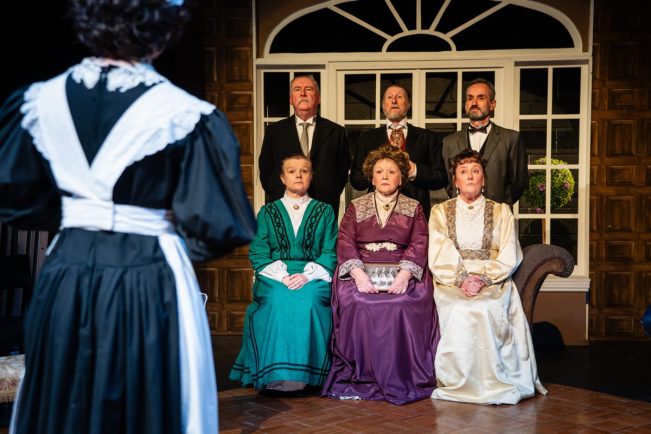
‘When We Are Married’ is one of his rare sorties into light farce as it tells its tale of three couples who discover 25 years after their joint wedding in 1883, that they were never legally wed but had been living in sin! As fine, upstanding members of Edwardian Society, this news would be devastating if it got out.
Priestley’s words may have little to say as a lesson in marriage manners today, but they remain a treasure chest of rich words and jolly humour; such clever and precious text to exploit. Indeed, there are some parts so sumptuous, it is like luxuriating in a deep bath filled with the finest salts.
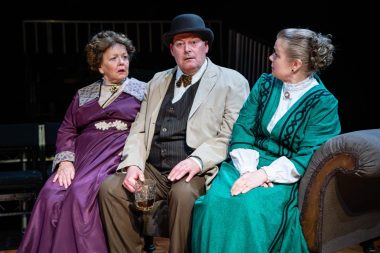
Picture by Graeme Braidwood Photography. s
Unfortunately, for me this latest Crescent production falls a little short in doing ‘JB’ justice; there is too much shouting and gabbling of lines – particularly early on by the three husbands. Golden rule – shout too much and you have nowhere to go and when the odd line calls on to be shouted – you have nothing new to give; seek and you will find guys – give us what the writer has given you!
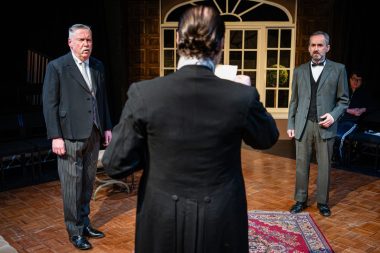
The production is performed in the round and the actors have been blocked to make sure that all audience areas have adequate sightlines. What falls short is the movement within the space itself – it often seems unsure with actors lacking in spacial awareness. One scene in Act One where the three wives advance on their husbands in slow motion and the men retreat is particularly clumsy – the men seem more fearful of bumping into the audience behind than the wrath of their spouses.
Please believe me when I say I was expecting another Crescent triumph, building on the golden run they are currently having – perhaps that expectance made my disappointment greater. However, the buck must stop somewhere and that has to be with the director. In fairness this is Nathan Hawkins’ first time riding solo so I suppose some of the culpability can be put down to inexperience. I am surprised though that the seasoned Andrew Cowie riding shotgun as his artistic advisor hasn’t jumped on the basic flaws. Whilst on a rant, I also felt the set furniture looked like it has been rescued from the local dump rather than a well-to-do Alderman’s household. Likewise, the blandness of the props. As Brenda Barber would have said to her Crescent Chairman husband ‘it’s not a jumble sale Ron!’
Picture by Graeme Braidwood Photography. s
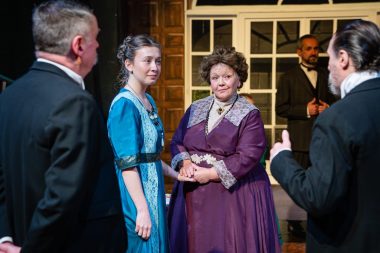
On the positive side the costumes in the capable hands of the Snapes were delightful. Likewise the intricacy of designer Keith Harris’s wooden floor was both practical and pleasing on the eye.
I do not blame the cast one bit for the disappointment – there is some huge talent in this company. Rising above the problems comes Pat Dixon-Dale with a firm handle on Maria Helliwell, Alderman Helliwell’s wife. Perfectly paced, exemplary characterisation with plenty of light and shade in delivery. Deronie Pettifer as Annie Parker and Shelly Smith as Clara Soppitt also hit the mark as the other two desperate housewives.
Eduardo White as Herbert Soppitt develops more depth in act two as does Phil Rea as Councillor Albert Parker but Ade Daniels as Joseph Helliwell continues to shout in a one-dimensional performance throughout, which is a great pity as I’m sure he has the ability to give much more. Joanne Hill would be excellent as the disgruntled chamber maid Mrs. Northrop if she reigned her performance back a few notches (especially that annoying laugh) and let the lines do the work.
Picture by Graeme Braidwood Photography. s
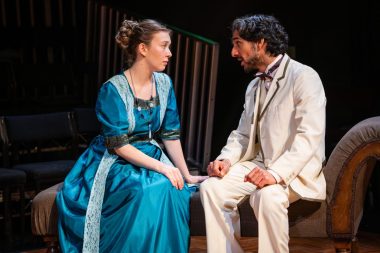
My stand outs go firstly Rei Byrne-Smith as the distinctly watchable chambermaid Ruby Birtle, she is both believable and engaging (though please slow down a little on the ‘giddiness’ when delivering important plot dialogue). Gillian Twaite is a delight as Lottie Grady with just the right degree of naughtiness and Rav Deu is calculatedly restrained as the Organist who first reveals the immorality of the three couples.
Top marks to Simon King as photographer and drunk Henry Ormonroyd who does not put a foot wrong throughout, his every word captures character and humour, and his every movement via his not insignificant frame is infectious – he made me smile, chuckle and roar.
Picture by Graeme Braidwood Photography. s
I am sure that as the run continues the cast will smooth out their own paths if they listen to the most important person – even though he’s been dead for nearly half a century.
The show runs at The Crescent until Saturday. Click here for times, tickets and more information.